


PBIS: The System That Makes Everything Else Work

“When a child doesn’t know how to read, we teach. When a child doesn’t know how to behave, we… teach?” - Tom Herner
If you want your academic systems to thrive, your behavior systems have to be just as intentional.
At Steenport Leadership Coaching, we believe PBIS (Positive Behavioral Interventions and Supports) is not an add-on, it’s foundational. Just like academics, we cannot assume students show up knowing exactly what we expect behaviorally. That has to be taught, modeled, monitored, and supported.
Think about it this way:
We define essential standards for reading and math.
We teach them at Tier 1.
We intervene at Tiers 2 and 3 when students struggle.
Behavior is no different. If your campus doesn’t yet have a strong PBIS system, or even a PBIS team, there is good news: you don’t need to overcomplicate this to see massive results in year one. Here are three high-leverage moves to get started.
1. Define What You Expect and How You’ll Teach It
Every strong PBIS system starts with clarity. You need two things working together:
Your Code of Conduct / School-Wide Rules
What students will be held accountable for
Your Tiered Behavior System (Tier 1, 2, 3)
How you will teach and support behavior
Too often, schools lean heavily on consequences without building the teaching side.
We have to remember: Students don’t always come to us with the same understanding of expectations.
Your job is to:
Identify 2–3 essential behaviors for the year
Teach them explicitly (just like a lesson)
Model what it looks like and sounds like
Monitor who is getting it and who is not
Then, your PBIS team develops:
Tier 2 supports for students who need more
Tier 3 interventions for students who need intensive support
This is where behavior becomes a system, not just a reaction.
2. Build a Team and Lock in School-Wide Expectations
If PBIS is everyone’s job, it must be led well. Your Assistant Principal should lead the PBIS team, with representation from across the campus. This is critical.
Why?
Because the power of behavior systems is in the people.
The team’s first major lift: Develop clear School-Wide Expectations (SWE)
These should define what behavior looks like in:
Classrooms
Hallways
Cafeteria
PE / Gym
Common areas
Not vague. Not assumed. Explicit. Then comes the most important part: Every adult holds tight to them.
When expectations are inconsistent:
Students get mixed messages
Teachers get frustrated
Admin gets overwhelmed
When expectations are tight and aligned:
Behavior improves
Referrals decrease
Teacher capacity increases
Consistency is the system.
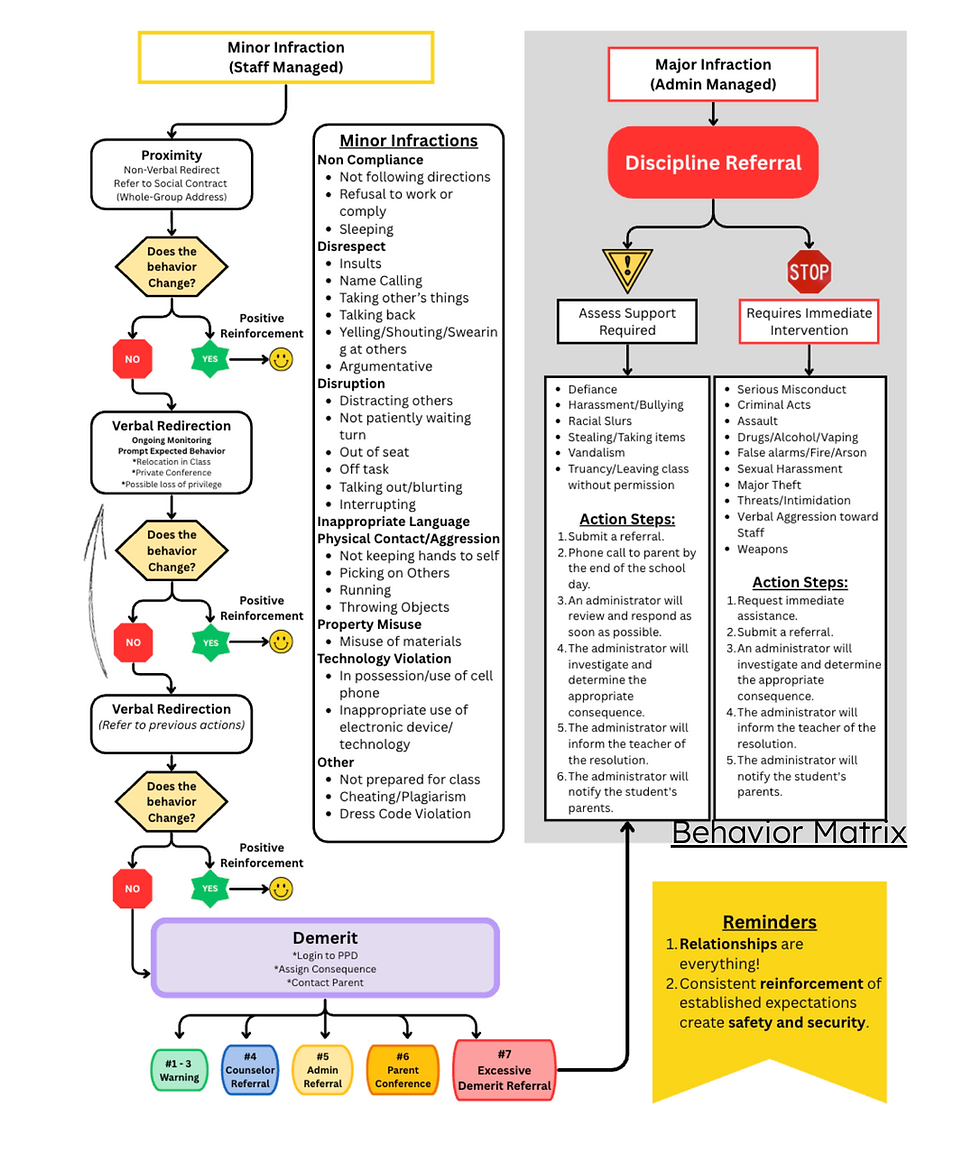
3. Create a Behavior Flow Chart (and Actually Use It)
This is where most systems either break or become incredibly effective. Your PBIS team must develop a clear behavior flow chart that answers: What is teacher-managed?
Examples:
Proximity
Redirection
Relationship-building
Parent contact
Classroom interventions
What is administrator-managed? Split into:
Low priority (handled within 24 hours)
Immediate (e.g., physical aggression)
This clarity does two things:
Protects instructional time
Builds teacher confidence and skill
But here’s the part that matters most: You must hold tight to the flow chart. You will inevitably see referral patterns where a small number of teachers write the majority of referrals
That’s not a compliance issue, it’s a coaching opportunity. The mindset should always be: “How do we support this teacher?”Not: “Why aren’t they following the system?” Strong PBIS systems are built through support, not blame.
What About Rewards? Many campuses ask about positive reinforcement systems and they can be powerful if done right.
But let’s be clear. A strong system balances accountability and recognition. Done well, recognition systems:
Celebrate students consistently doing the right thing
Acknowledge students making progress (Tier 3 → Tier 2 → Tier 1)
Done poorly, they:
Accidentally reward negative behavior
Undermine expectations
You’ve likely heard it: “A student gets a referral and comes back with a sucker.” That will crush your system. If you build a reinforcement system:
Tie it directly to your expectations
Recognize growth—not just perfection
Never reward misbehavior
The Rhythm of a Strong PBIS System
Your PBIS team should meet monthly and focus on:
Reviewing behavior data
What’s improving?
Where are we struggling?
Monitoring essential behaviors
Are students learning them?
Are teachers teaching them consistently?
Adjusting Tier 2 and 3 supports
Refining any recognition systems
At the end of the year:
Conduct a full reflection
Use data to determine next year’s focus
Final Thought
A well-functioning PBIS system does not happen by accident.
It is:
Clear
Collaborative
Data-driven
Consistently implemented
And when it’s done right, something powerful happens: Behavior improves. Classrooms stabilize. And academic systems finally have room to work. If you want better outcomes for students, start here.
PBIS isn’t extra work. It’s the work that makes everything else possible.



Comments